
At the International Language Institute (ILI), we believe the best way to learn a language is to live it. And what better place to live your Spanish than Mexico – a country full of history, culture and genuine warmth?
From vibrant cities to peaceful villages, Mexico offers endless opportunities to practice your Spanish in real-life situations. You’ll meet people from all walks of life, experience regional traditions, and deepen your understanding of Latin American cultures – all while building confidence and fluency in the kind of positive learning environment you’ve come to expect from us.
Learning Spanish in Mexico isn’t just about language. It’s about connection, transformation, and seeing the world through new eyes. And if you’ve had your eye on the news of late, you’ll know Mexico – under the leadership of Claudia Sheinbaum, Mexico’s first woman and first Jewish president – continues to champion progressive ideals, respect, and equality with a dose of national pride and the celebration of Mexican culture and values. I think we can get behind that.
Choosing the right school and destination to learn Spanish in Mexico
This is the part you really don’t have to worry about. ILI Massachusetts is part of an international family of quality language schools with shared values, academic and pedagogic principles.
We’re all unique and special in our own ways while enjoying a lot of common ground in our approaches to language education. That means your Spanish immersion classes in Mexico are going to feel reassuringly familiar in some ways, and refreshingly different from a cultural perspective. It’s a win-win!
Factors to consider when selecting a Spanish language school
Our international network of like-minded schools means we’ve taken the risk out of choosing the best Spanish immersion classes in Mexico, but there’s still plenty of latitude for you to do the fine-tuning yourself to find the best place for you.
Here are some questions to help steer your choice of a Spanish language school in Mexico:
- Are you most interested in the language or the culture of Mexico? What are your non-negotiables that you want to experience while you’re there?
- What kind of climate suits you best? What environment? Do you thrive in the middle of a vast city, or must you be able to get out occasionally to connect with nature, or feel the sea breeze?
- Do you need to make quick progress and come back with a significant improvement in your Spanish, or is it more about enjoying the ride and seeing, hearing and using the Spanish language in context?
- Are you super-comfortable in a popular tourist destination or do you love to blend in?
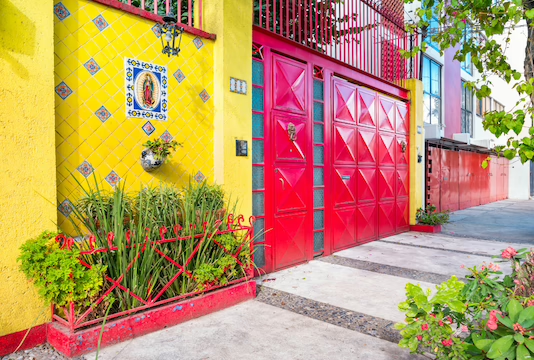
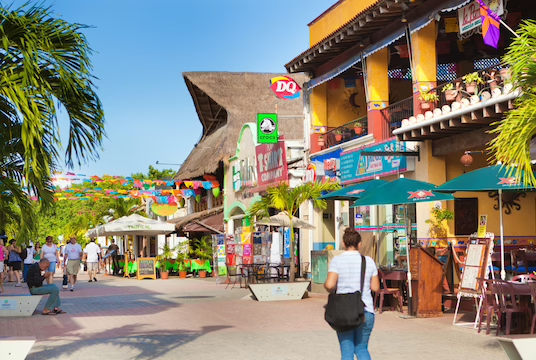
Popular destinations for Spanish language study in Mexico
So is there a best place to learn Spanish in Mexico? That depends a lot on you and what you’d love the most.
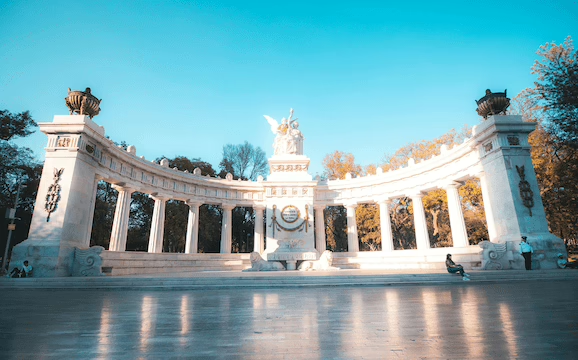
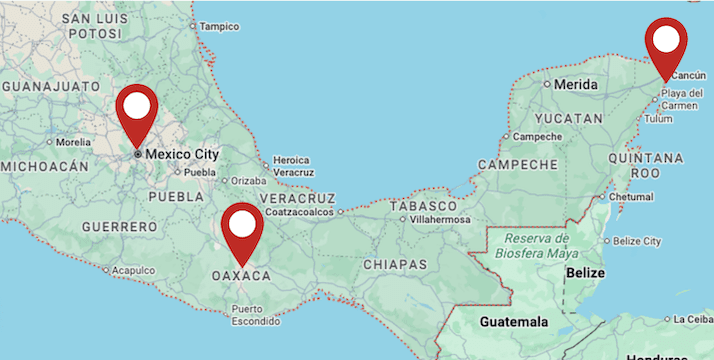
Do you crave the relative quiet of a smaller town to learn Spanish in Mexico, or are you ready for all the vibrancy, the street life, the music or the surprisingly frequent public announcements in the street that the country can throw at you? If so, then Mexico City is the first choice for that full-on, volume up experience. With its 9 million+ inhabitants in the downtown area alone, a Spanish immersion in Mexico City will be just that!
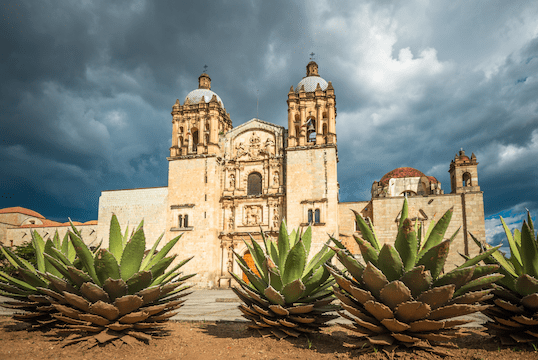
We do have two truly tantalizing alternatives for you. First there’s Oaxaca City, nestled in the foothills of the Sierra Madre mountains with around 300,000 inhabitants. Think rich, deep running culture and texture, indigenous culture, art and exquisite food.
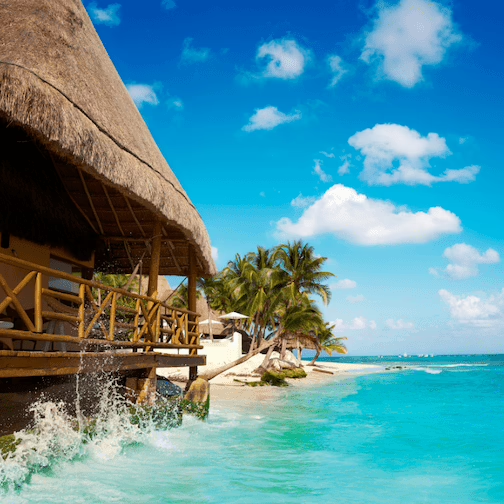
Then, up and away on the Eastern coast of the Yucatán peninsula with its white sand Caribbean beaches, you have Playa del Carmen. It’s where you can get your fill of Mayan ruins, but that Caribbean influence creates a rich international cultural mix, where you might also find Cuban and Dominican fusions in food, music and lifestyle.
Pros and cons of different regions
Each region is a gem in its own right. Let’s take them one by one.
If Mexico City feels like an option, to an extent it’s a city that’s ‘always on’, but still there’s a fair difference between the peak season of March to May and late October to early November (Día de los Muertos) where you’re going to get gorgeous weather (70-80°F) but big crowds and higher prices. The quieter season is January to early March (temperatures are in the early 60s°F) and August to September (milder 70s°F with afternoon rain).

Oaxaca likely feels more rooted – deeply cultural, slower in pace, but still lively when it counts. The peak season hits in late October to early November (for Día de los Muertos) and again in July for the Guelaguetza Festival. During these times, the weather is beautiful – 75 to 85°F, dry and sunny, but you’ll also see big crowds. That said, by booking with us and our partner schools, you’re going to be sure of a more authentic experience, as our local activity organizers know the best locations slightly off the tourist trail.
The quiet season runs from mid-January to March, and again in May to early June. It’s still warm (low 70s°F), especially in the day, and the city breathes a little more deeply. It’s a good time to connect with locals, explore artisan markets, and generally take your time.
If Mexico City is the capital of movement and Oaxaca is the capital of art and tradition, Playa del Carmen is the capital of chill, but that depends when you go!
The peak tourist season runs from December through April, when the Caribbean weather is near perfect: 80 to 88°F, with low humidity and sunny skies. It’s ideal beach weather, but in all honestly, you’ll likely share it with international tourists and cruise ships with the high-season prices to match.
For a quieter, more local vibe, consider May to June or September to November. Expect hotter, humid days (85 – 95°F) with a higher chance of rain or afternoon storms. Honestly, we think it adds to the mood, and who doesn’t want to dance in the rain occasionally? It’s the off-season, so things slow down, prices drop, and the crowds thin – making space for a more relaxed, everyday version of Playa.
Everyday Life as a Spanish Language Student in Mexico
What we love is that you’re going to get an authentic Mexican experience when you travel with us, which is so very different from being wheeled off a cruise ship, or bussed in from the airport to be fed from the fixed menu of package travel.
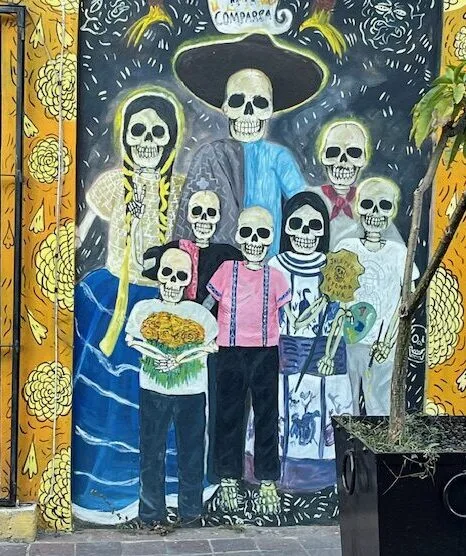
ILI is a la carte, and whichever Spanish language school you choose in Mexico, there’s plenty of freedom for us – together – to cook up the perfect Mexican language experience for you. If you have time on your side, you could combine Spanish language learning with archeological discovery, or volunteering in the community or on environmental projects. You could focus on Business Spanish, particularly useful to pick up those latin linguistic nuances which will help build better work relationships. Or, of course, you could dive into Mexican cuisine or dance, and take a Spanish program which is combined with afternoon cooking classes or latin dance classes.
And of course, you can combine your dream program with afternoon sightseeing, evening drinks and fantastic food (everywhere) with your new-found classmates, plus weekend activities to the top sights and historical gems of this incredible country.
What are you hungry for? Let’s explore options together! Ready to start the conversation? Get things started
Cultural differences to be aware of
While Mexico shares broad values like community, and family and education with our home here in western Massachusetts, there are some interesting differences too.
- In Mexico, community is central and life is about proximity to family, intergenerational social gatherings, open and personal connections and lots of talking over food. In Western Mass, we might be a bit more individualistic and private, however friendly.
- In Mexico, time is more fluid and the pace of life calmer. Your lessons will still start on time, but arriving up to 30 minutes late for social events is common and not rude. Leave your judgy pants at home, go with the flow, and enjoy the holiday from the social pressure you grew up with. This also works!
- In Mexico, you take time with food – especially the main meal (comida) of the day. Enjoy the conversation. Talk to strangers. Go with the flow. If you’re invited back to eat with their family, this is massive and a tremendous opportunity to integrate.
- While LGBTQ+ and gender rights are progressing in Mexico, western Mass will have the edge here. Urban areas will tend to be more open, while rural areas could still be more conservative. Much like back home, right?
Learning Spanish effectively in Mexico
You may ask yourself whether Mexico is a good place to learn Spanish, what kind of Spanish you might come back with, and whether that will clash at all with what you’ve learned at home.
Tips for improving your pronunciation and accent
You’re going to find that Spanish immersion in Mexico exposes you to a crisp, clean and fairly neutral form of Spanish, which is a huge help, especially if you’re more towards the beginner end of the spectrum. If anything you might lose a little bit of enunciation as you hit Playa del Carmen with its Caribbean influence, but for that, the prevalence of international tourism there can mean people make a bit of extra effort too.
And if you return with a bit of a Mexican twang in Spanish, it’s going to be a talking point – it’s still going to be understood, and it’s still going to be great Spanish.
Strategies for building vocabulary and grammar skills
Be prepared to pick up local variants of vocabulary and local expressions in both Oaxaca and Playa. It’s no different from learning a few phrases of Basque while you’re learning Spanish in San Sebastian.
Like every other Spanish immersion school we can send you to from ILI, your classes will be at the heart of how you learn and progress with your vocabulary and grammar. But if the classes are where you stock up on new language, the location you choose is your playground, and you won’t find a population more delighted that you’re speaking to them in Spanish, and more happy to talk to you.
The benefits of immersion and cultural exchange
We talk a lot about the benefits of Spanish language immersion at ILI. It’s a rite of passage in your language learning journey, whether you fit it in sooner or later as you work up through the levels (this is something we discuss in the article “Best Way to Learn a Language: At Home or Through Immersion Abroad?”).
But there’s something super-timely about visiting Mexico right now. The world as we know it seems to have gone a bit sideways, and we’ve seen a lot of high-level political friction between the USA and Mexico. You know that at ILI we look far past these headlines and we seek out shared humanity across borders. And Mexico has this by the bucketload. I’d say that because of the tension up top, it’s a fantastic time to meet some real Mexicans, learn all about Mexican culture, life, language and heritage, and show that you care, that you’re not the American stereotype here.
Exploring Mexico while learning Spanish
Must-see attractions and destinations
You’ll find a ludicrously large number of things to do in each of our recommended Spanish immersion destinations in Mexico. In all honesty, we don’t think it’s about ticking every last museo and templo off the list, but excursions are a great way to learn about Mexican culture and also give you lots of opportunities to chat with your Mexican group leader and your classmates (in Spanish, of course!) as you wander streets, take in the sights, and absorb… everything!
Popular activities and experiences
Throw these lists into Google to bring some of these top tourist attractions into full, zinging color:
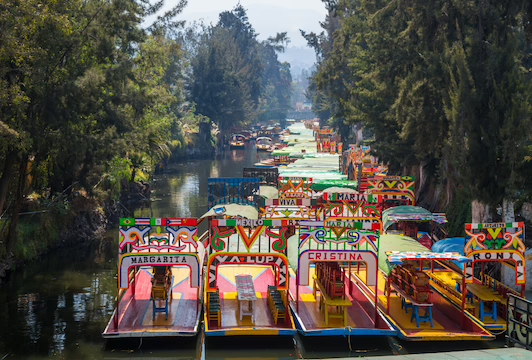
Mexico City: Zócalo, Templo Mayor, Museo Frida Kahlo, Chapultepec Park and Castillo, Xochimilco Canals, Museo Nacional de Antropología, Roma and Condesa neighborhoods, Lucha Libre events, street food tours.
Oaxaca City: Monte Albán, Templo de Santo Domingo, Mercado Benito Juárez, Mercado 20 de Noviembre, Hierve el Agua, Teotitlán del Valle, Guelaguetza Auditorium, mezcal tastings, cooking classes.
Playa del Carmen: Playa Mamitas, Playacar Beach, Cenote Azul, Cenote Jardin del Eden, Cenote Dos Ojos, Fifth Avenue (La Quinta Avenida), Xcaret Park, Tulum Ruins, Coba Ruins, ferry to Cozumel, yoga on the beach, local dance classes.
Tips for traveling safely and responsibly
The usual common-sense rules apply wherever you travel – don’t flash your fancy things around, be discreet with your money, keep your valuables safe in busy and tourist-heavy areas, and be respectful of local people and customs.
Remember that there is always a differential in terms of your buying power in other countries, so comments like “Gee, your food is so cheap here”, and “I’m thinking of buying a condo on the beach as a third home” are not the best ice-breakers.
What’s lovely about our partner schools for your immersion program in Mexico is that they’ll give you a detailed briefing on the first day, and explain some local dos and don’ts, so you don’t have to worry about doing or saying the wrong thing, or somehow landing yourself in trouble. We’ve got you covered there.
Budgeting and Finances
The good news is that for the average US citizen, you’re going to find that living costs in Mexico are generally 60-80% cheaper than at home. However, you’re unlikely to get full access to those prices, as, by being a tourist, you’re contributing to the economy, probably staying in a nice hotel (or homestay, of course), eating at fancy restaurants, and more.

So it’s going to be good value for money in Mexico, but we’d urge you to be OK about paying the prices you’re asked to pay. It’s also good practice to tip 10-15% in restaurants and leave small change in cafes, round up the cost of taxis and tip people in hotels. Again, no need to be flashy, just kind. When you get to the school in Mexico, they’ll have more details on this too, so you can pay your way and get on the right side of people, with confidence.
Visa and Accommodation in Mexico
At the time of writing, if you’re a US citizen, you don’t need a visa for short stays of up to 180 days when travelling to Mexico. You’ll receive a tourist card (Forma Migratoria Múltiple) when you arrive. You return the card when you leave, so keep it safe at all times. Your passport needs to have at least 6 months of validity and you’ll need to show your return tickets and occasionally proof of sufficient funds if you’re planning to stay for longer. That’s about it. If the situation changes, we’ll update you when you inquire with us.
So there you have it, your Spanish language student guide to Mexico. If you’ve got this far, ¡Qué chido! (“How cool!”). Naturally we hope you’ll book your exciting Mexican escapade with us at ILI.
Here’s more information about Spanish Immersion Programs in Mexico, but if you really cannot wait a second longer, get in touch with us and we’ll be super-happy to hear about you and your plans, and tell us what you’re hoping for. ¡Hasta pronto!
Related Articles
- Best Way to Learn a Language: At Home or Through Immersion Abroad?
- Beyond the screen: Applying your online Spanish in the real world
- Maximize your dollar: Budget tips for Spanish language students in Colombia
- Beginner to Intermediate Spanish: 4 Simple Steps to Achieve it
- Explore all the Spanish speaking destinations ILI partners with abroad
- Build a foundation by taking a Spanish class at ILI first before going abroad.